

Ajido-Marujido
IndoForum VIP: The Special One
- No. Urut
- 10016
- Sejak
- 31 Des 2006
- Pesan
- 4.815
- Nilai reaksi
- 146
- Poin
- 63
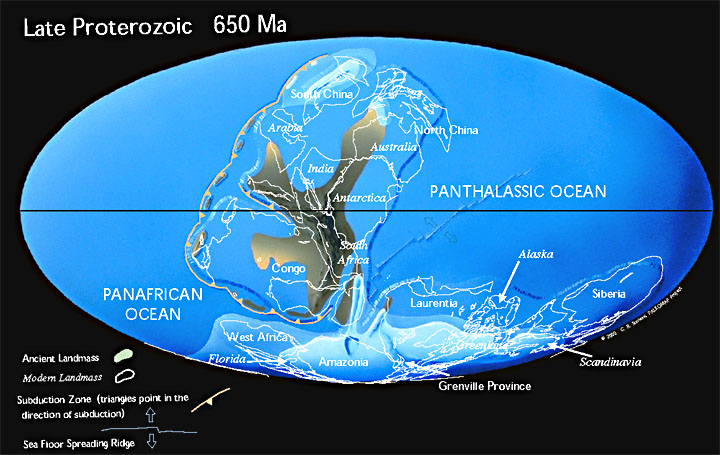
Late Precambrian Supercontinent and Ice House World
This map illustrates the break-up of the supercontinent, Rodinia, which formed 1100 million years ago. The Late Precambrian was an "Ice House" World, much like the present-day.

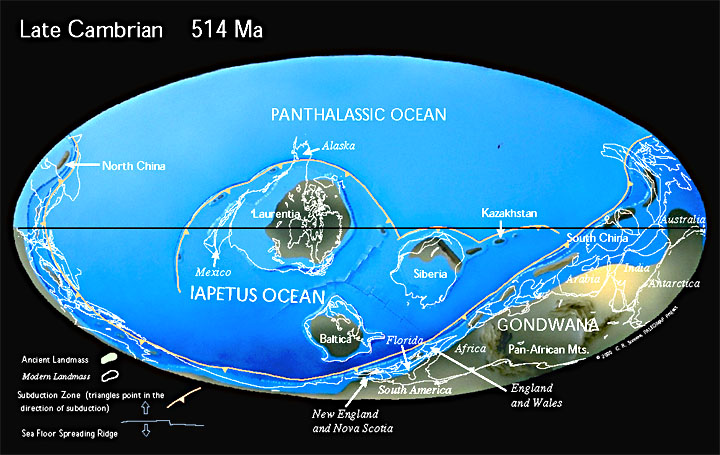
Cambrian: the beginning of the Paleozoic Era
Animals with hard-shells appeared in great numbers for the first time during the Cambrian. The continents were flooded by shallow seas. The supercontinent of Gondwana had just formed and was located near the South Pole.
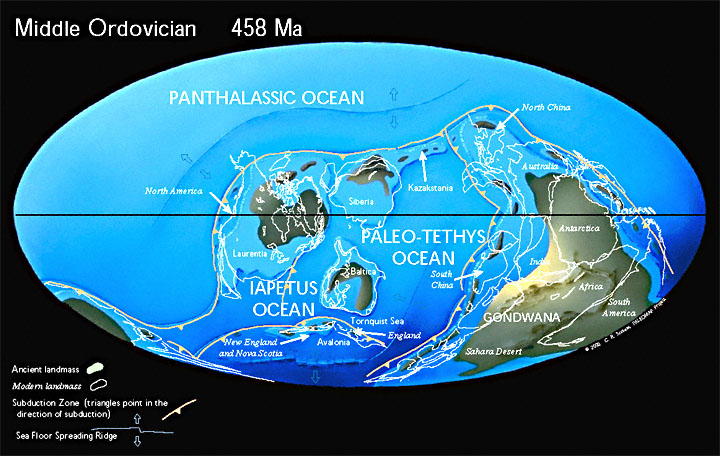
Ancient Oceans Separate the Continents
During the Ordovician ancient oceans separated the barren continents of Laurentia, Baltica, Siberia and Gondwana. The end of the Ordovician was one of the coldest times in Earth history. Ice covered much of the southern region of Gondwana.
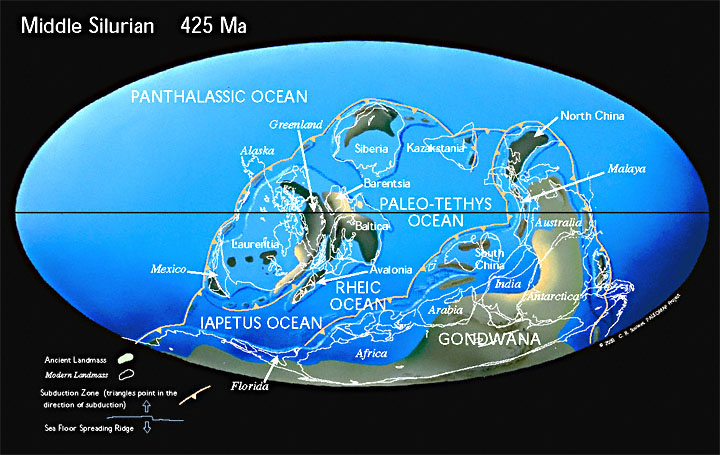
Continents Begin to Collide as Paleozoic Oceans Close
Laurentia collides with Baltica closing the northen branch of the Iapetus Ocean and forming the "Old Red Sandstone" continent. Coral reefs expand and land plants begin to colonize the barren continents.
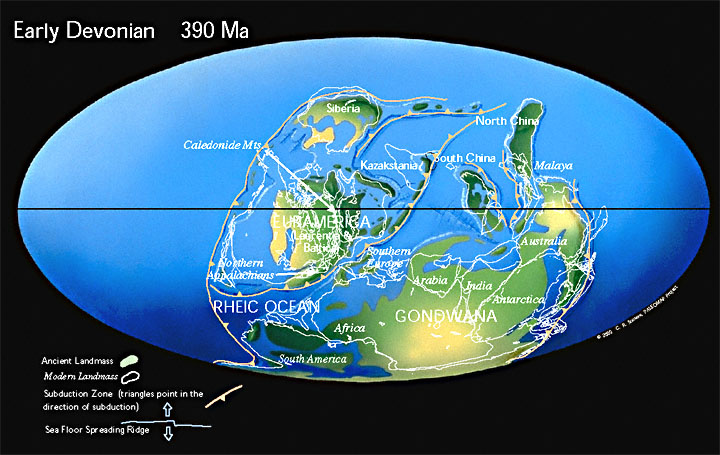
The Devonian Was the Age of Fish!
By the Devonian the early Paleozoic oceans were closing, forming a "pre-Pangea". Freshwater fish were able to migrate from the southern hemisphere continents to North America and Europe. Forests grew for the first time in the equatorial regions of Artic Canada.
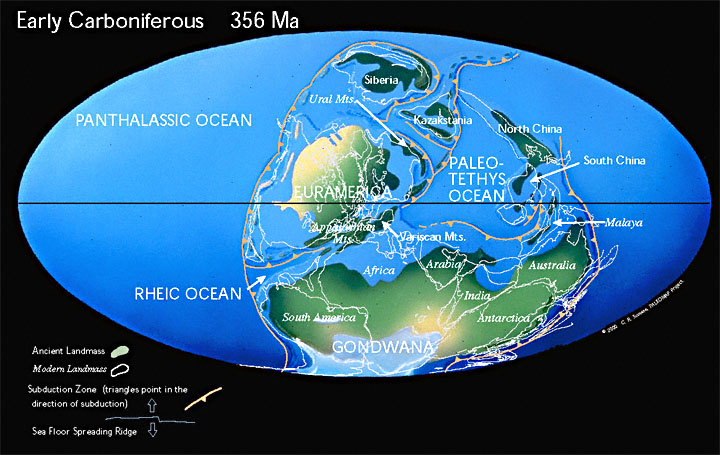
During the Early Carboniferous Pangea Begins to Form
During the Early Carboniferous the Paleozoic oceans between Euramerica and Gondwana began to close, forming the Appalachian and Variscan mountains. An ice cap grew at the South Pole as four-legged vertebrates evolved in the coal swamps near the Equator.
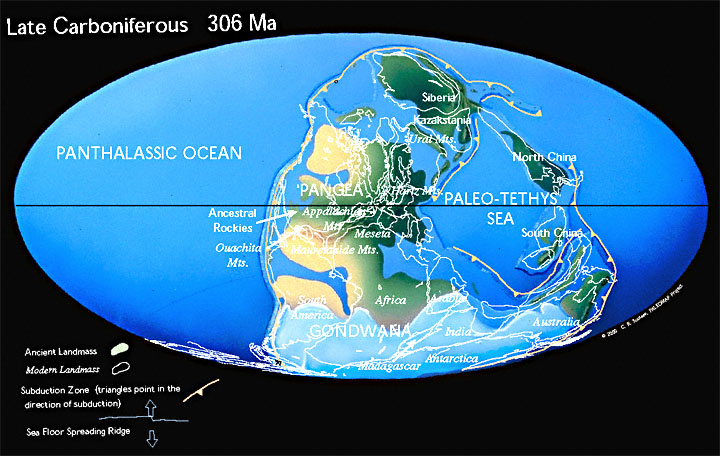
The Late Carboniferous a Time of Great Coal Swamps
By the Late Carboniferous the continents that make up modern North America and Europe had collided with the southern continents of Gondwana to form the western half of Pangea. Ice covered much of the southern hemisphere and vast coal swamps formed along the equator.
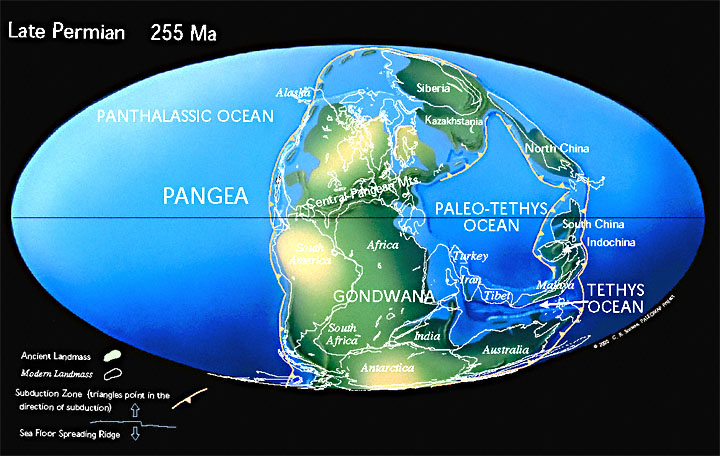
At the end of the Permian was Greatest Extinction of All Time
Vast deserts covered western Pangea during the Permian as reptiles spread across the face of the supercontinent. 99% of all life perished during the extinction event that marked the end of the Paleozoic Era.
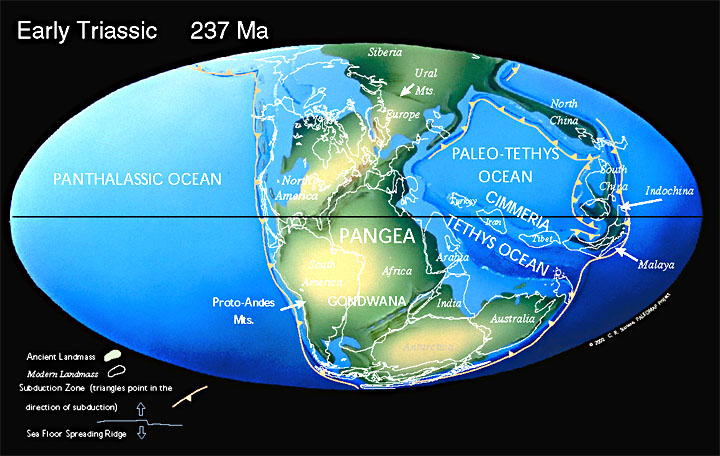
At the end of the Triassic, Pangea began to rift apart.
The supercontinent of Pangea, mostly assembled by the Triassic, allowed land animals to migrate from the South Pole to the North Pole. Life began to rediversify after the great Permo-Triassic extinction and warm-water faunas spread across Tethys.
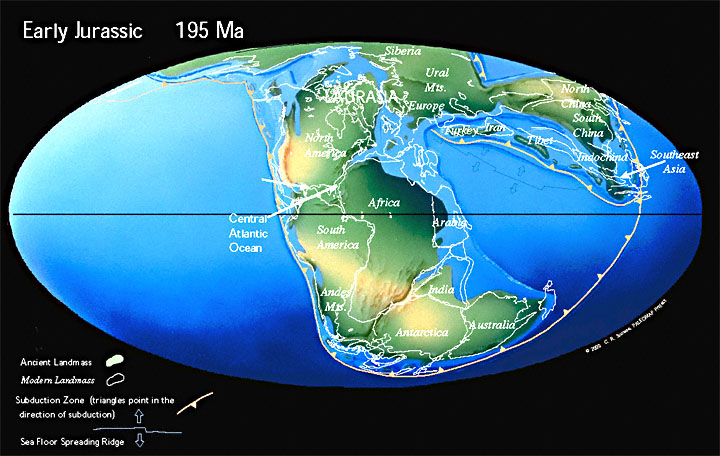
Early Jurassic, the Dinosaurs spread across Pangea
By the Early Jurassic, south-central Asia had assembled. A wide Tethys ocean separated the northern continents from Gondwana. Though Pangea was intact, the first rumblings of continental break up could be heard.
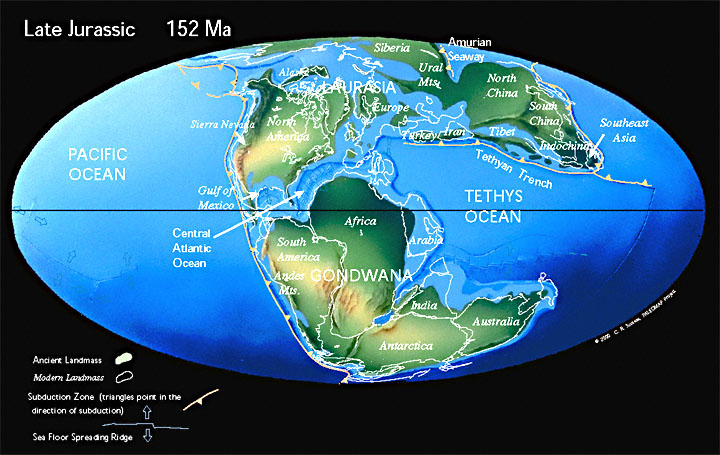
Pangea Begins to Rift Apart
The supercontinent of Pangea began to break apart in the Middle Jurassic. In the Late Jurassic the Central Atlantic Ocean was a narrow ocean separating Africa from eastern North America. Eastern Gondwana had begun to separate form Western Gondwana.
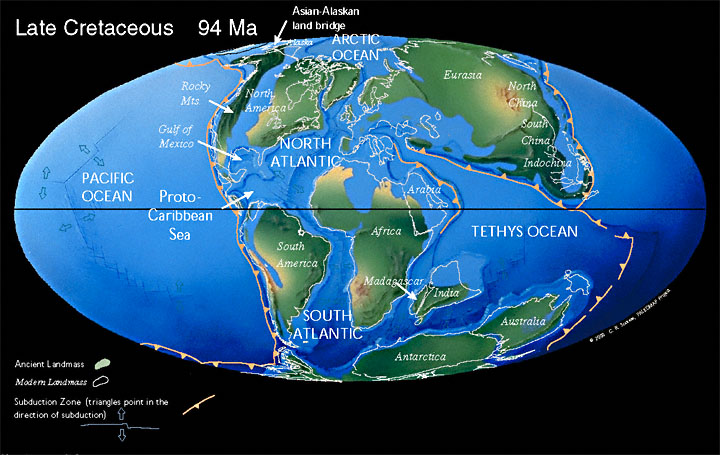
New Oceans Begin to Open
During the Cretaceous the South Atlantic Ocean opened. India separated from Madagascar and raced northward on a collision course with Eurasia. Notice that North America was connected to Europe, and that Australia was still joined to Antarctica.
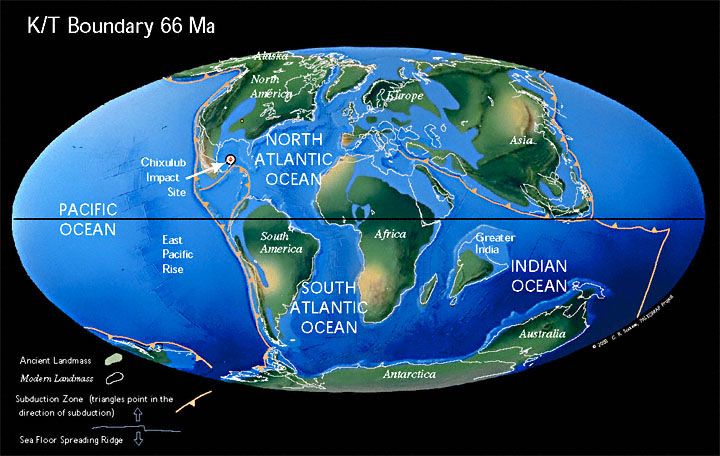
The End of the Dinosaurs
The bull's eye marks the location of the Chicxulub impact site. The impact of a 10 mile wide comet caused global climate changes that killed the dinosaurs and many other forms of life. By the Late Cretaceous the oceans had widened, and India approached the southern margin of Asia.
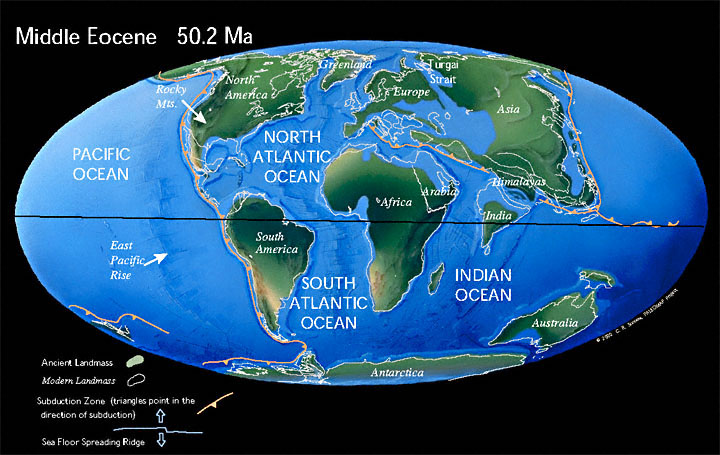
During the Early Cenozoic India began to Collide with Asia.
50 - 55 million years ago India began to collide with Asia forming the Tibetan plateau and Himalayas. Australia, which was attached to Antarctica, began to move rapidly northward.
During the Early Cenozoic India began to Collide with Asia.
50 - 55 million years ago India began to collide with Asia forming the Tibetan plateau and Himalayas. Australia, which was attached to Antarctica, began to move rapidly northward.
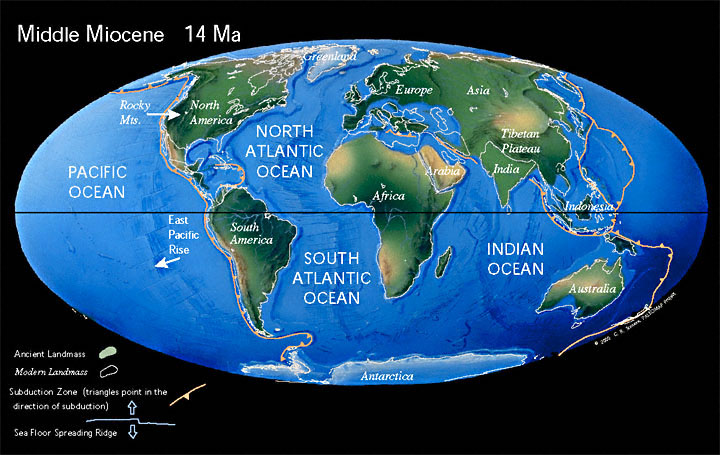
The World Assumes a Modern Configuration
20 million years ago, Antarctica was coverd by ice and the northern continents were cooling rapidly. The world has taken on a "modern" look, but notice that Florida and parts of Asia were flooded by the sea.
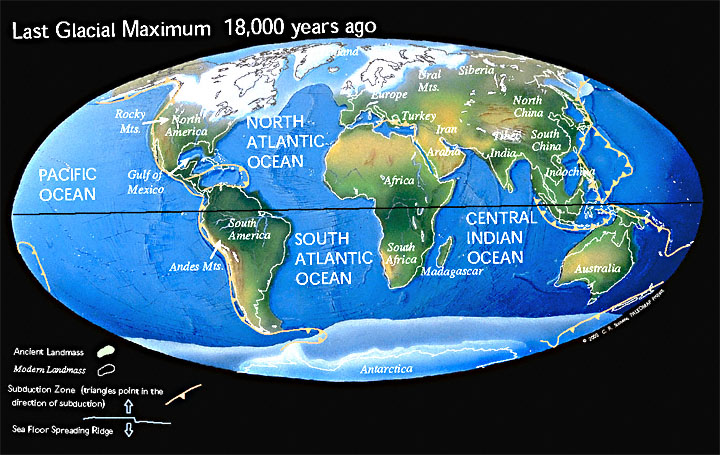
The Earth has been in an Ice House Climate for the last 30 million years
When the Earth is in its "Ice House" climate mode, there is ice at the poles. The polar ice sheet expands and contacts because of variations in the Earth's orbit (Milankovitch cycles). The last expansion of the polar ice sheets took place about 18,000 years ago.
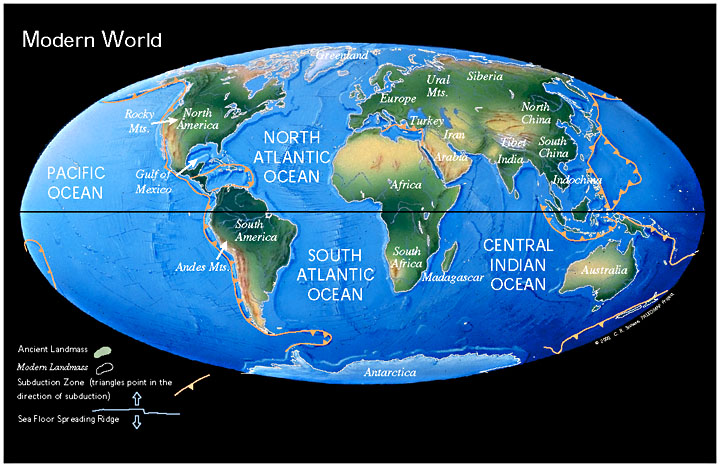
The Present-day world has well defined climatic zones.
We are entering a new phase of continental collision that will ultimately result in the formation of a new Pangea supercontinent in the future. Global climate is warming because we are leaving an Ice Age and because we are adding greenhouse gases to the atmosphere.
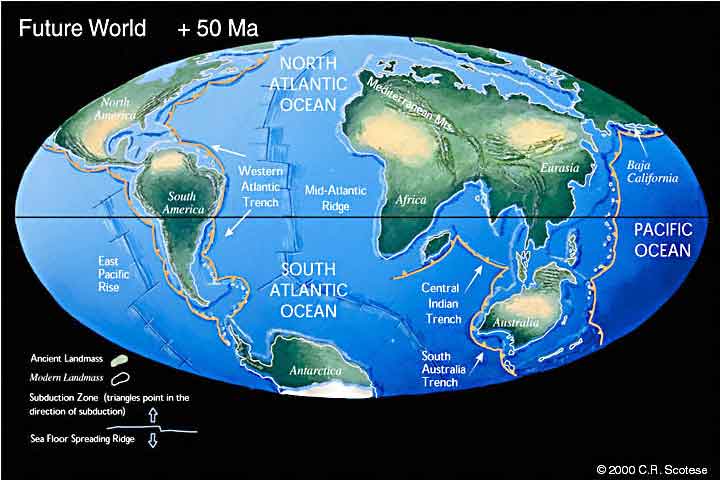
This is the way the World may look like 50 million years from now!
If we continue present-day plate motions the Atlantic will widen, Africa will collide with Europe closingthe Mediterranean, Australia will collide with S.E. Asia, and California will slide northward up the coast to Alaska.
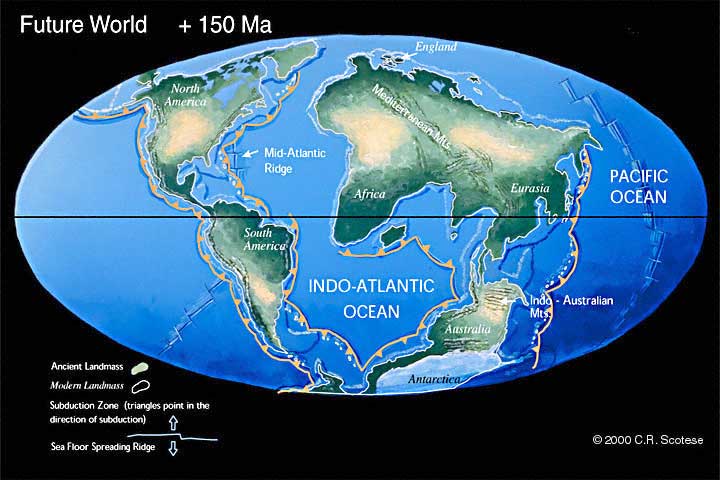
The Atlantic Ocean begins to Close
New subduction zones along the eastern coasts of North America and South America will begin to consume the ocean floor separating North America from Africa. About 100 million years from now the present-day Mid-Atlantic Ridge will be subducted and the continents will come closer together.
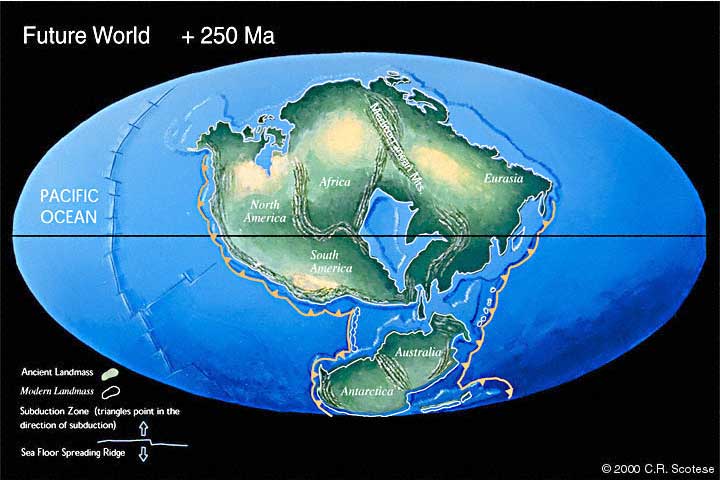
"Pangea Ultima" will form 250 million years in the Future
The next Pangea, "Pangea Ultima" will form as a result of the subduction of the ocean floor of the North and South Atlantic beneath eastern North America and South America. This supercontinent will have a small ocean basin trapped at its center.
sumber: http://www.scotese.com/earth.htm


